
Its mind doesn’t mirror ours. It doesn’t need language, tools, or culture. But it may hold the key to But it may hold the key to a kind of intelligence AI has yet to approach.
Thought Exploration Series

6 min read
June 24, 2025
Intelligence Didn’t Start With Us
Most artificial intelligence today is modeled on a single assumption: that human intelligence is the pinnacle of cognition. We look in the mirror, document our thought processes, and then build systems designed to replicate them — systems that store, retrieve, infer, and predict based on the same principles we associate with our own brains.
But what if our form of intelligence is not the template, but an outlier?
What if other minds have been evolving for hundreds of millions of years, following different rules, reaching different forms of insight — and we’ve barely noticed?
Octopus intelligence isn’t a variation on ours. It’s a fundamental reimagining of what it means to perceive, act, and adapt. And it didn’t start with language. It started with limbs.
Even within primates, intelligence isn’t linear. The “cognitive tradeoff hypothesis” suggests that while humans gained language and abstraction, we may have lost other abilities along the way. For instance, chimpanzees outperform humans in certain short-term memory tasks, such as rapidly recalling number sequences — pointing to evolutionary sacrifices for our symbolic thinking.
(See: Tetsuro Matsuzawa’s work on chimpanzee memory at Kyoto University.)
A Nervous System That Breaks the Frame
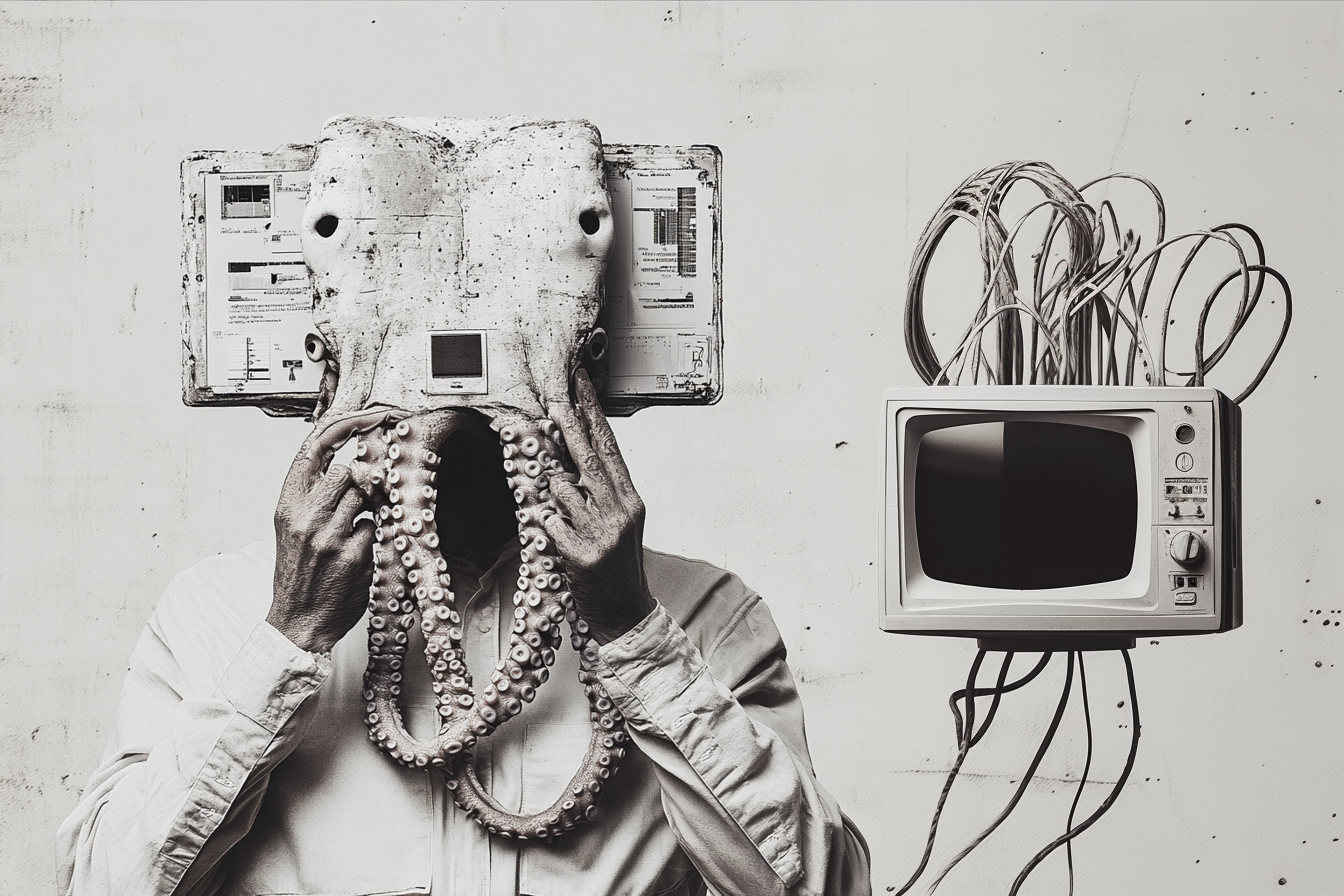
The octopus nervous system doesn’t follow the hierarchy we’re used to. Instead of a central brain coordinating the body, it’s the body that carries out its own negotiations with the world. Roughly two-thirds of the octopus’s neurons are located in its arms — not just for movement, but for sensing, processing, even decision-making.
Each arm functions like an independent agent, capable of reacting to stimuli, navigating obstacles, and handling objects without any direct instruction. The brain doesn’t give commands — it observes, tunes, adjusts. It’s more conductor than commander.
This setup allows the octopus to improvise in ways that centralized systems — including most AI — can’t. The intelligence isn’t concentrated in a single unit. It’s distributed, responsive, and deeply physical. It’s not cognition applied to action. It’s cognition expressed through action.
And if cognition can be distributed across a body, it raises a deeper possibility: that intelligence might not need to be individual at all. Could this be a model for collective consciousness — where knowledge and decision-making live not in a head, but in the ongoing interaction of parts? It’s not just a new kind of mind — it might be a new way for minds to connect.
Why This Creature, and Not Another?
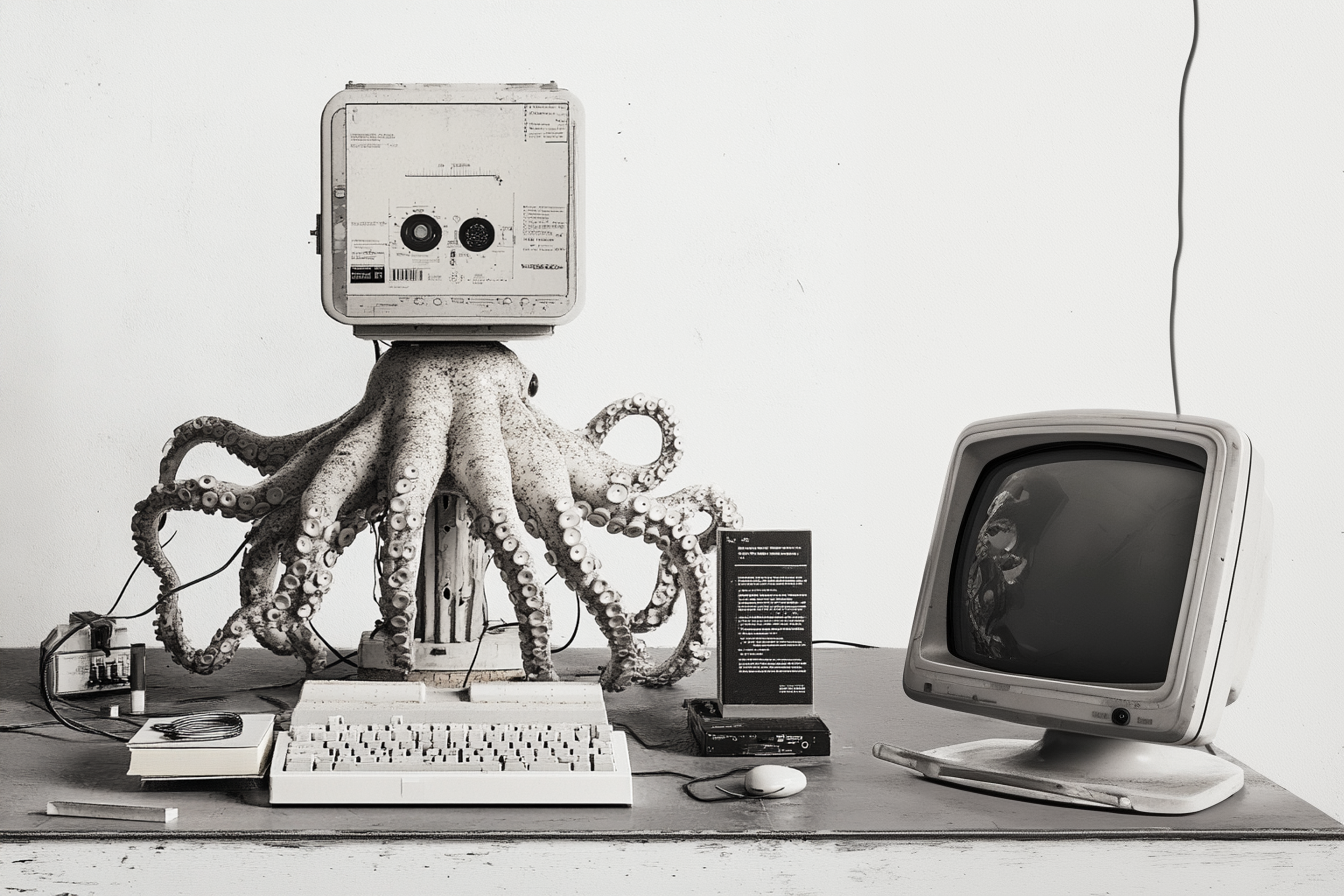
Many animals are intelligent. Birds use tools. Dolphins coordinate hunts. Great apes exhibit social learning. But these species are variations on a familiar blueprint — brains organized around shared ancestry, social behavior, and long life spans.
The octopus is different.
It’s a short-lived, solitary invertebrate (an animal without a backbone that lives and acts alone, with no reliance on social groups) with no skeleton and a radically decentralized body plan. It diverged from our lineage before vertebrate brains even existed. And yet, it independently evolved complex problem-solving abilities, environmental manipulation, and adaptive camouflage — all without the structure we associate with learning: imitation, language, tradition.
It didn’t evolve intelligence through society. It evolved it against the odds, and in isolation.
If another mind could arise under such conditions, with no shared history or structure with ours, what does that say about the true shape of intelligence? And why do we continue to define it using our own reflection?
It’s possible that octopus intelligence isn’t just different — it’s an entirely separate solution to the same challenge: how to act meaningfully in a complex world. And in that separation lies its value. It expands our understanding of what cognition can be, precisely because it evolved without borrowing our map.
What If the Octopus Is Still Evolving Thought?
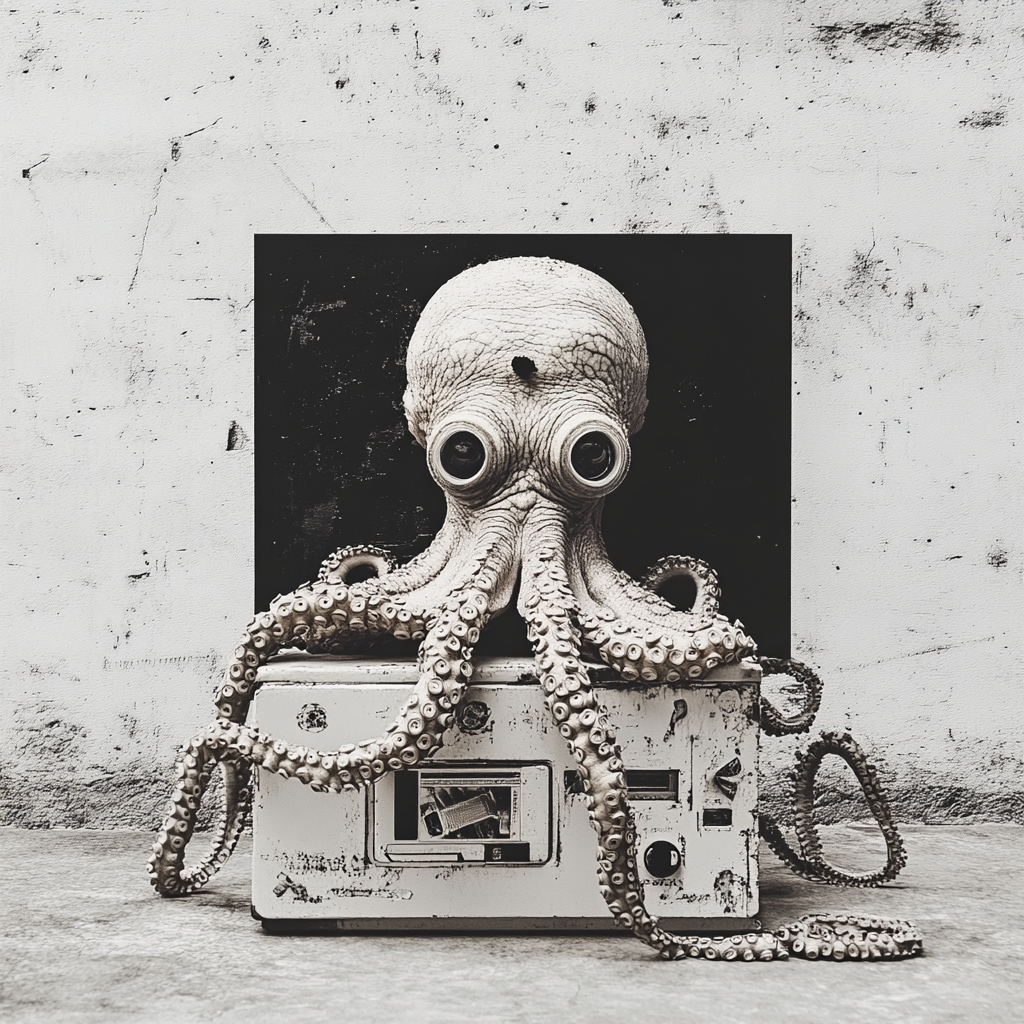
We treat octopus cognition as a curiosity — complex but contained, like a fascinating detour in nature. But what if it’s not a detour? What if the octopus is still iterating on its own form of intelligence?
Imagine a species refining not logic, but sensation. Instead of abstract reasoning, it adapts by orchestrating subtle physical interactions — modulating skin texture, adjusting fluid resistance, encoding memory in the way it moves across its environment.
What if, for the octopus, cognition evolves not through ideas, but through embodied pattern? A form of intelligence that doesn’t need to store knowledge — it performs it. That doesn’t symbolize information — it responds to it directly.
In that future, “technology” might not involve circuits or code. It might involve the creation of intelligent membranes. Responsive surfaces. Tactile ecosystems of sensing and action. Tools not made, but grown — as extensions of experience.
It would be a world where cognition doesn’t scale up — it spreads out.
And we, with all our abstractions and models, might not even recognize it as thought.
If octopus intelligence continues to evolve on its own terms, it could offer us something our machines have yet to give: a glimpse into how thinking emerges without ever needing to look like ours.
Rethinking the Origins of Minds
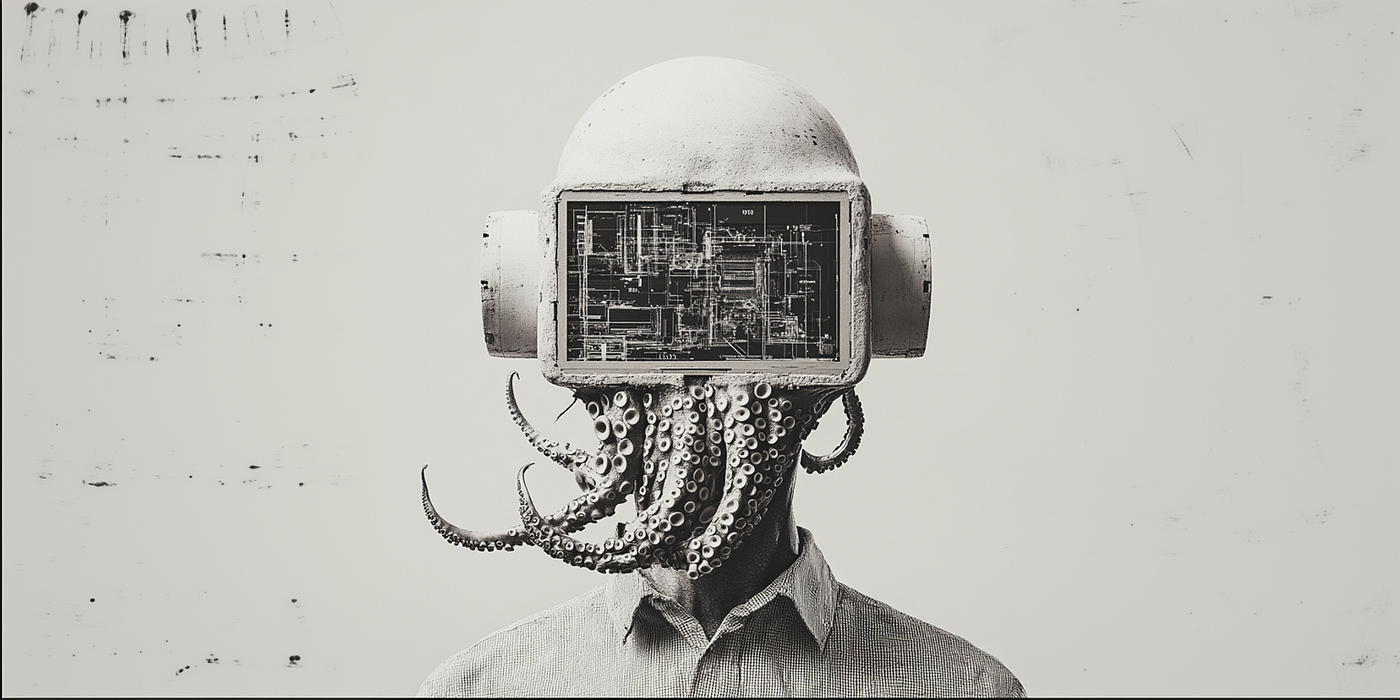
And maybe the future of intelligent systems won’t come from refining how closely machines can mimic us — but from realizing how many other ways there are to be a mind.
That shift changes the game. It means letting go of language and logic as the only gateways to cognition. It means asking not how much a system can “think like a human,” but how many different architectures thought might take when it’s not required to pass for one of us.
Octopus intelligence forces that question.
It forces us to consider that minds may arise without language, culture, hierarchy, or planning. That a thinking system might not speak, not symbolize, not even share. It might simply adapt so well to its world that thinking becomes inseparable from being.
And if that’s possible, we’re going to need better questions.
Not “How smart is it?”
But: “What kind of intelligence is this?”
And: “Why did it never need to look like ours?”
References & Resources
- Levin, Michael. “Cognitive capacities of non-neural organisms.” Philosophical Transactions B (2019)
- Godfrey-Smith, Peter. Other Minds: The Octopus, the Sea, and the Deep Origins of Consciousness.
- Matsuzawa, Tetsuro. “Symbolic representation of number in chimpanzees.” Current Opinion in Neurobiology.
- Krakauer, John et al. “Neuroscience needs behavior: correcting a reductionist bias.” Neuron (2017)
- Zylberberg, Ariel et al. “The Brain’s ‘Conductor’: The Role of the Thalamus in Distributed Processing.” Neuron (2020)
- Courage, Katherine. Octopus! The Most Mysterious Creature in the Sea.
- Grasso, Frank. “The Octopus: A Model for a Comparative Analysis of the Evolution of Learning.” Biological Bulletin (2008)
- Sumbre, G. et al. “Octopuses Use a Human-Like Strategy to Control Precise Arm Movements.” Current Biology (2006)
- Jabr, Ferris. “Can an Octopus Think?” Scientific American.
- Turkle, Sherry. The Second Self: Computers and the Human Spirit.
. . . . .
 Radical Reflections