
Thought Exploration Series
Inspired by Yuval Noah Harari’s quote: “AI is no longer just a tool — it is an agent.”
“The tools we use have a profound (and devious!) influence on our thinking habits, and therefore on our thinking abilities.”
— Neil Postman
For much of human history, thinking was considered a solitary act. A quiet endeavor between an individual and their own mind. A scientist under a tree. A philosopher in a study. A writer alone with a pen.
In this model, thought was internal — personal, bounded, and shaped by a single consciousness.
But that boundary has dissolved.
Today, when someone says, “Let me think about it,” they might not be taking a walk to clear their mind. More likely, they’re opening a browser tab. Running a query through ChatGPT. Exploring prompts. Skimming summaries. Synthesizing what others have already thought, written, designed, or generated.
We’re not just thinking anymore.
We’re thinking with machines.
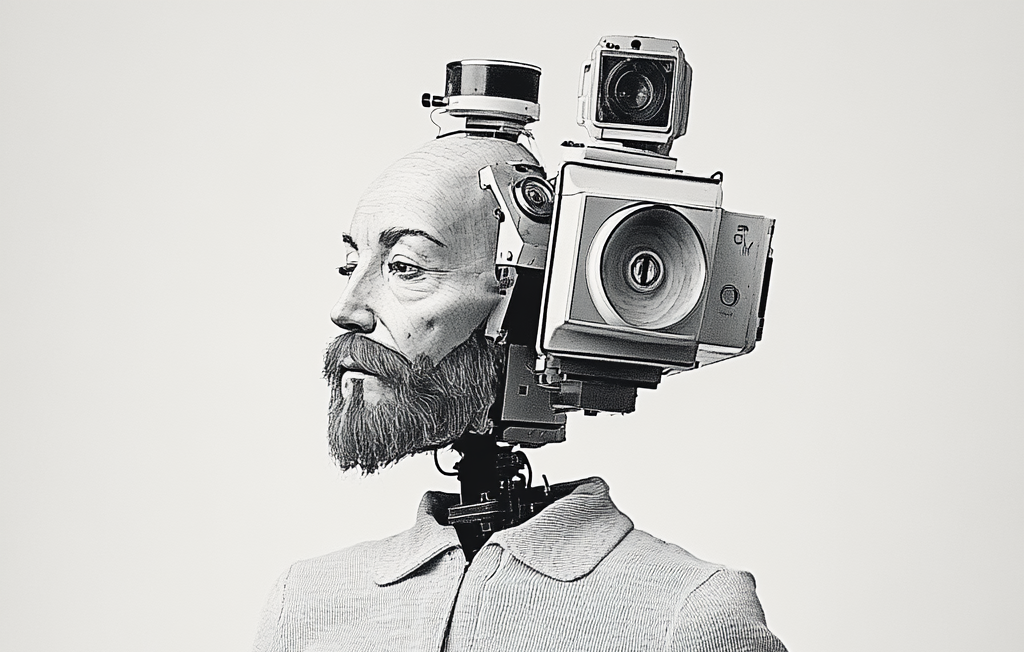
The Inner Discussion Is No Longer Inner
Generative AI has quietly, but profoundly, changed the cognitive landscape. It’s not just a productivity tool, or even a helpful thought partner. It’s something more subtle and far-reaching: a thought shaper.
These systems don’t merely respond. They influence.
They suggest frames we hadn’t considered. They remix our language. They nudge us toward certain formulations, metaphors, or patterns.
And while this guidance is often useful — even illuminating — it’s rarely neutral.
Once you type out an idea, it’s no longer just yours. It becomes part of a shared, generative ecosystem — fuel for the next round of training data. Our thoughts, once ephemeral, are now searchable. Indexable. Remixable. And in a way, communal.
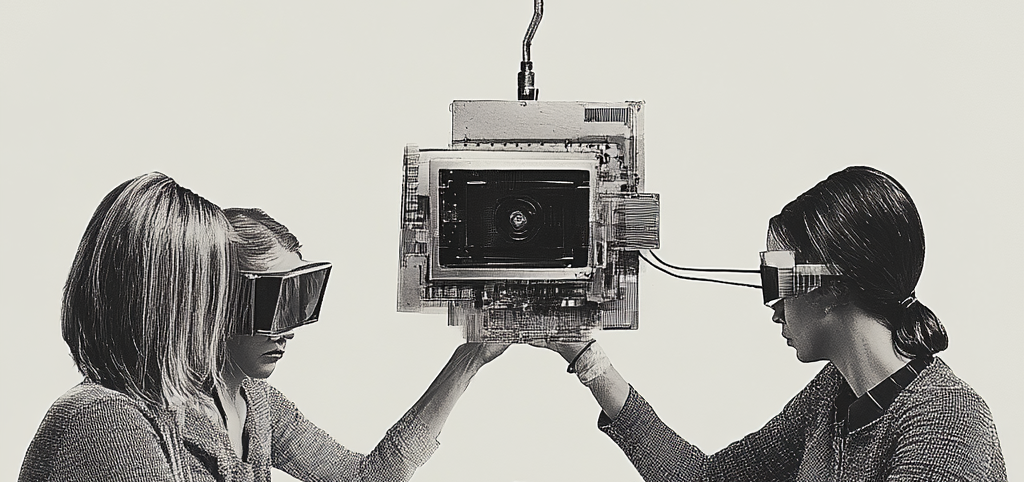
We Never Thought Alone — But Now the Room Has Changed
Of course, not all thinking was ever done in isolation. Some of our most valuable insights emerge from collective cognition: the push-and-pull of a good debate, the flow of ideas in a workshop, the unexpected brilliance sparked by a throwaway comment in a feedback session.
AI doesn’t just transform how we think alone — it reconfigures how we think together.
With generative tools, a single person can simulate a group brainstorm. Multiple perspectives, instant responses, counterpoints delivered on demand. What once required a team can now unfold at the speed of a prompt.
That might sound like evolution. In some ways, it is.
But there’s a cost: the serendipity, contradiction, and emotional nuance that only real human interaction provides.
When the friction of disagreement is replaced by clean, compliant outputs — what kinds of ideas do we start to lose?

The Newton Under the Tree Is Now Talking to GPT
We romanticize the lone genius — the Newtons and Einsteins of history, thinking in isolation. But the modern version of that thinker isn’t in a garden waiting for apples. They’re connected. Searching. Prompting.
They’re not thinking from scratch. They’re thinking with scaffolding — and the scaffolding is built from millions of other people’s contributions, compressed and replayed through machine logic.
It’s not necessarily worse. But it’s certainly different.
When we ask AI to help us brainstorm, we’re accelerating ideation — but perhaps diluting its depth. When we ask for next steps, we skip the uncertainty that often leads to real originality.
Twenty decent ideas in sixty seconds sounds efficient.
But creativity doesn’t always thrive in efficiency.
. . . . .
The Stat That Should Make You Pause
Here’s one number that puts this transformation into perspective:
According to IDC, 90% of the world’s data was generated in the past two years.
That’s not a typo. And generative AI is training on all of it.
Each draft, email, photo caption, and search query feeds the models that now return answers in seconds. Our digital exhaust is shaping the intelligence we interact with daily.
It raises a question: If AI knows our patterns better than we do — what happens when we start thinking in ways it already expects?
. . . . .
The Paradox of Generative Knowledge
We now live in an era where knowledge is infinite, instantly accessible, and effortlessly packaged. It’s a technological triumph. But it brings with it a quiet paradox.
If AI can produce competent content on demand — across writing, code, visuals, and beyond — do we begin to assume that what exists is enough?
Do we start to confuse generation with progress?
There’s a subtle risk here: that the flood of already-generated ideas makes it easier to recycle than to wrestle. That we stop building new frameworks because the old ones are so conveniently available.
The fear isn’t that AI will replace us.
The fear is that we might stop evolving — because it’s just easier to borrow.
. . . . .
The Call
This isn’t an argument against AI.
It’s a call for intentional authorship.
Let AI stretch your thinking — but not define it.
Let it illuminate blind spots — but don’t hand it the steering wheel.
Use it as a mirror, not a mask.
Because while our thoughts may now move through shared systems and synthetic scaffolds, what we choose to think still matters.
In a world where we can borrow brains…
we’re still responsible for what we build with them.
Is AI expanding your mind — or outsourcing your thinking?
Let’s talk.

 Radical Reflections